What these three crosses have in common
The Aussie Mountain Doodle, the Bernedoodle, and the Aussiedoodle are all designer crosses, not breeds recognized by the AKC or other major kennel clubs. Each one carries Poodle on one side of its family tree, which is what gives all three their reputation for low-shedding, low-dander coats. The Poodle parent is the constant. What actually separates these dogs is the non-Poodle parent, and that single difference reshapes energy, temperament, size, and the health questions a careful buyer should ask.
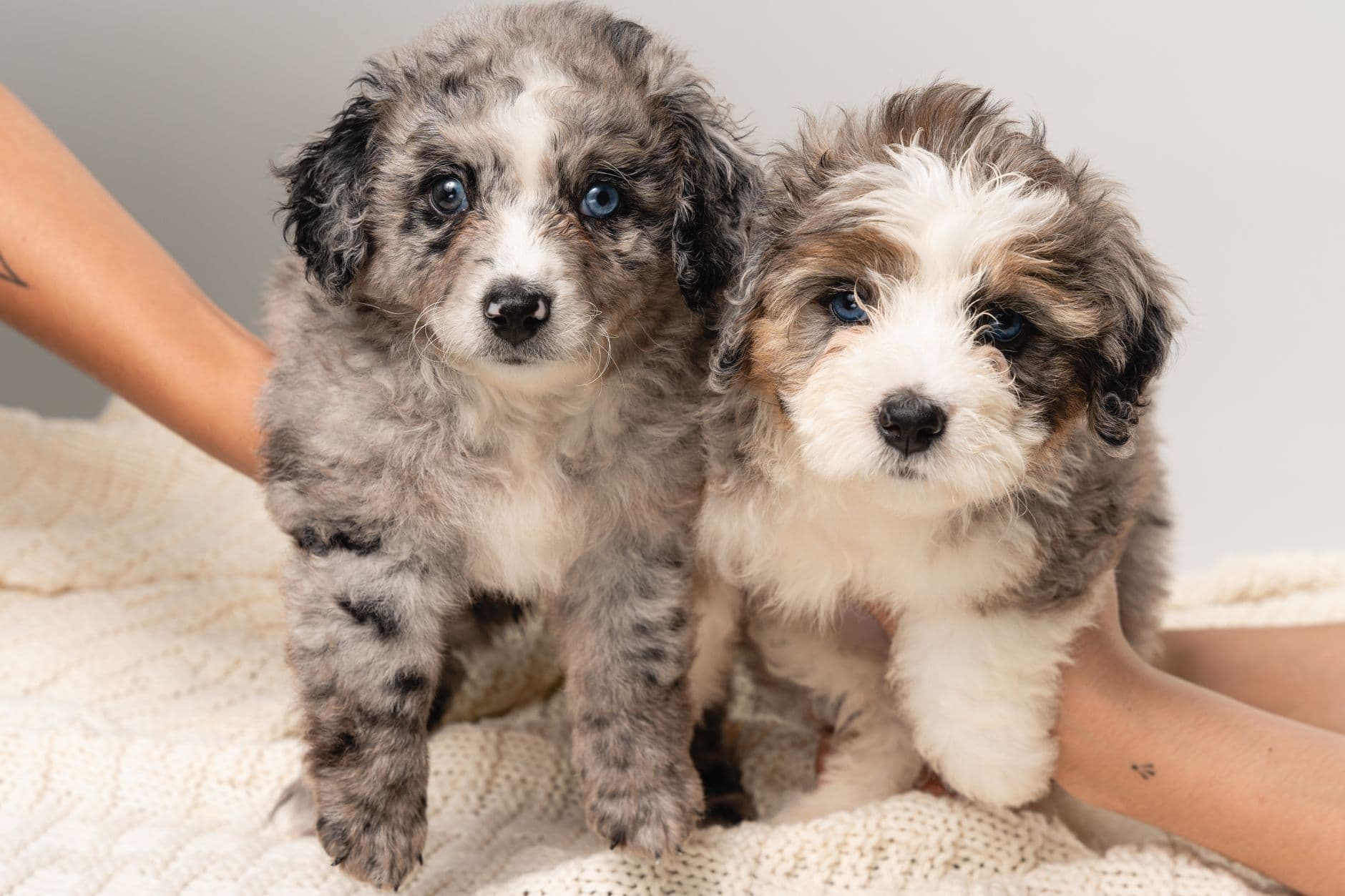
Here is the short version. An Aussiedoodle is an Australian Shepherd crossed with a Poodle: bright, busy, and built to work. A Bernedoodle is a Bernese Mountain Dog crossed with a Poodle: bigger, calmer, and famously gentle. An Aussie Mountain Doodle folds all three lineages together, usually by breeding an Aussiedoodle to a Bernedoodle, so it blends Aussie drive with Bernese mellowness. Definitions for the Aussie Mountain Doodle vary from breeder to breeder, so read the actual parentage on any litter rather than trusting the label alone. Our Aussie Mountain Doodle guide goes deeper on how that tri-cross is built.
The three crosses at a glance
| Feature | Aussiedoodle | Bernedoodle | Aussie Mountain Doodle |
|---|---|---|---|
| Parent breeds | Australian Shepherd x Poodle | Bernese Mountain Dog x Poodle | Australian Shepherd, Bernese, and Poodle lineage (often Aussiedoodle x Bernedoodle) |
| Typical size range | Mini to standard, roughly 10 to 70 lb depending on the Poodle used | Mini to standard, roughly 25 to 90 lb, often the largest of the three | Wide range, commonly 25 to 75 lb depending on the parents |
| Energy level | High | Low to moderate | Moderate, blended |
| Temperament | Smart, driven, eager, sensitive | Gentle, affectionate, easygoing | Affectionate and alert, calmer than a pure Aussiedoodle |
| Coat and shedding | Wavy to curly, low shedding | Wavy to curly, low shedding | Wavy to curly, low shedding |
| Trainability | Very high, needs a job | High, more relaxed pace | High |
| Lifespan range | Roughly 10 to 13 years | Roughly 12 to 15 years | Roughly 12 to 15 years |
| Best-fit home | Active, experienced, outdoorsy | Calmer family wanting a gentle giant | Family wanting energy with an off switch |
The ranges above are widely cited general figures, not guarantees. A breeder using a Toy or Miniature Poodle produces a much smaller dog than one using a Standard Poodle, so always ask which Poodle size sits behind the litter.
Energy and exercise compared
This is the dividing line that trips up the most families. The Aussiedoodle inherits the Australian Shepherd's herding engine. These dogs are happiest with a real outlet: long walks, fetch, hiking, dog sports, or a yard and a job to do. Skip the exercise and the brains turn into mischief, from counter-surfing to nipping at heels. If you run, hike, or compete in agility, an Aussiedoodle will keep up with you and ask for more.
The Bernese side pulls the Bernedoodle in the opposite direction. A Bernedoodle still needs daily movement, but it is content with a good walk and then a long nap at your feet. It is the cross most likely to match a quieter household pace. The Aussie Mountain Doodle usually lands in the middle. It wants activity and mental work like the Aussie line, but the Bernese influence tends to give it an off switch, so it settles indoors more readily than a pure Aussiedoodle. Individual dogs vary, so meet the parents and watch how they wind down.
Temperament and family fit
All three are people-focused and affectionate, but they show it differently. Aussiedoodles are intensely bonded and sensitive, which makes them quick learners and also quick to absorb a chaotic or harsh home. They can be reserved with strangers, a trait that pairs well with early, steady socialization. Bernedoodles lean patient and tolerant, the classic gentle dog that shrugs off a busy kid-filled living room. The Aussie Mountain Doodle aims to combine the Aussie's loyalty and smarts with the Bernese's calm, which is exactly why people seek the tri-cross out.
For homes with young children, the calmer Bernedoodle or a well-bred Aussie Mountain Doodle is often the easier fit. A high-drive Aussiedoodle can be wonderful with kids too, but only when the family has the time to channel its energy. You can read more about how these temperaments play out day to day in our Bernedoodle breakdown.
Coat and grooming
Because the Poodle is on every side of these crosses, all three tend toward wavy or curly, low-shedding coats that many allergy-sensitive families tolerate better than a heavy-shedding breed. Be honest with yourself, though: no dog is truly hypoallergenic, and dander and saliva still carry allergens. If allergies are a serious concern, spend time with the specific dog before committing.
Low shedding does not mean low maintenance. These coats trap loose hair instead of dropping it, so they mat without regular care. Plan on brushing several times a week and a professional groom every six to eight weeks for all three. Earlier-generation crosses can have straighter coats that shed a little more, while curlier coats need more diligent grooming to stay free of mats. Ask the breeder what the coat will likely become as the puppy matures.
Health profile differences
This is where the non-Poodle parent matters most, and where plain talk beats hype. The Aussie line brings a specific consideration: a genetic variant called MDR1, also written as the ABCB1 gene, that affects how some dogs process certain common medications. Australian Shepherds carry this variant at meaningful rates, so it can pass into Aussiedoodles and Aussie Mountain Doodles. A simple DNA test tells you a dog's status, and knowing it lets your veterinarian avoid or adjust the drugs involved. It is manageable once you know, which is the whole point of testing.
The Bernese line brings different awareness. Bernese Mountain Dogs are known in breed circles for shorter lifespans tied to cancer and for cardiac concerns. One of the genuine arguments for the Bernedoodle is that crossing with the longer-lived Poodle tends to improve on the Bernese's notably short lifespan and widens the gene pool. That is a reasonable hope, not a promise, so responsible breeders still screen. Across all three crosses, hips, elbows, eyes, and heart are the standard checkpoints, along with breed-relevant DNA panels. A trustworthy breeder will show you results, not just assurances. We cover what to ask for, cross by cross, in our guide to health testing for each cross.
Which should you choose?
Match the dog to your real life, not the life you wish you had.
- Active, outdoorsy family or individual: the Aussiedoodle rewards people who exercise hard and train consistently. Hikers, runners, and dog-sport homes thrive with this cross.
- Calmer household with kids: the Bernedoodle is the gentle, patient option that settles into family rhythm with a daily walk and plenty of affection.
- You want energy with an off switch: the Aussie Mountain Doodle is built for the family that wants a smart, playful dog that also relaxes indoors.
- Allergy-sensitive home: any of the three may suit you, since all favor low-shedding coats, but test your reaction to the individual dog first.
- First-time owner: proceed carefully with the high-drive Aussiedoodle. A Bernedoodle or a calmer Aussie Mountain Doodle is usually the gentler learning curve.
One honest caveat ties all of this together. These are crosses, and especially in earlier generations, individual variation can outweigh the breed averages above. A particular Bernedoodle might be busier than a typical Aussiedoodle, and a given Aussie Mountain Doodle might lean hard toward one parent. Meet the dog, meet the parents if you can, and choose the individual in front of you. When you are ready, you can find a breeder and start asking the right questions.
Find a Aussie Mountain Doodle Breeder
Dedicated, single-breed breeders. Want to be listed here? Add your kennel.
Sassy Pants Pups
Cortez, CO
Family-run program raising health-tested Aussiedoodles, Bernedoodles, and Aussie Mountain Doodles as companion and service-dog candidates, placed with a two-year genetic health guarantee.
Visit WebsiteList Your Kennel Here
Are you a dedicated Aussie Mountain Doodle breeder? Add your kennel to our directory for free.
Add Your Website